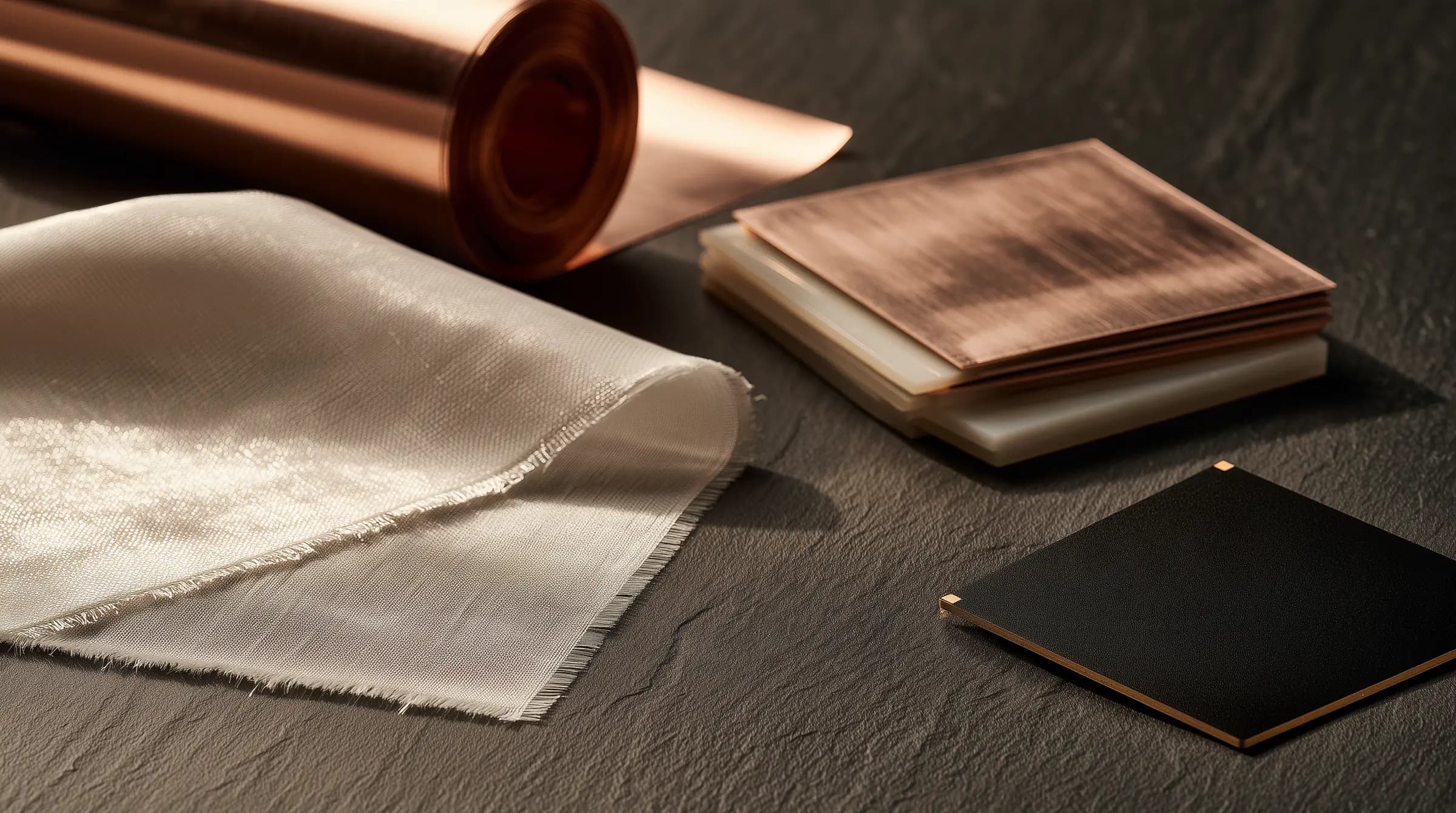
Printed circuit board makers spent 2026 competing for materials. Kingboard Laminates reported that a shortage of electronic glass fabric forced some laminate producers to partially suspend production in the first half of the year.[1] A circuit board is a different product from a microchip, and the shortage sits in board materials: glass cloth, copper foil, resin and the laminates made from them. This note sets out what is short, what is not, and whether supply is sufficient by board type, with evidence to mid-October 2026.
Key points
- A printed circuit board is a laminated panel of glass cloth, resin and copper foil. IC package substrates use finer grades of the same inputs and share the shortage.[2]
- Specialty glass cloth is the tightest input: Nittobo holds about 90% of T-glass supply, and its new Fukushima capacity starts in early 2027.[3][4]
- The squeeze has reached standard FR-4: laminate lead times rose from a few days to about four weeks, and Kingboard raised prices in 10 rounds from 2025 to July 2026.[5][6]
- HVLP copper foil is short, and LME copper averaged about 44% more in the third quarter of 2026 than a year earlier.[7][8]
- MPBxChange reads mainstream boards as available at higher prices, while AI-grade boards and IC substrates face allocation until new capacity runs in 2027 and 2028.[9]
- Thailand is adding laminate, prepreg and glass-fabric plants from late 2026 to 2028; high-end materials are still imported.[10][11]
How a printed circuit board differs from a microchip
A microchip is a silicon die on which a wafer fab builds transistors and wiring at nanometre scale. A printed circuit board is a laminated panel of glass-reinforced resin and patterned copper that holds packaged chips, passive components and connectors and wires them together. A PCB plant laminates, drills and plates; it makes no transistors.
The IC package substrate sits between the two: a small, fine-line board inside the chip package that fans the die's dense connections out to a pitch a PCB can accept. Low-expansion glass cloth goes mainly into substrates, and low-dielectric cloth into the board layers beneath AI chips.[2] Counterpoint Research estimates that an advanced AI chip uses roughly ten times the ABF build-up film of a traditional PC chip.[12]
The microchip and its package
- 1Silicon die: the microchip itself. Its transistors are made in a semiconductor wafer fab.
- 2IC package substrate: a fine-line board inside the chip package that spreads the die's connections out to a wider pitch.
- 3Solder balls join the chip package to the board.
The printed circuit board
- 4Copper foil: the conductor of every circuit layer, etched into traces and pads.
- 5Prepreg: woven glass-fibre cloth soaked in resin. It bonds the layers together and insulates them.
- 6Core laminate (copper-clad laminate, CCL): cured glass cloth and resin with copper on both faces.
- 7Plated via: a drilled hole, plated with copper, that connects the layers.
- 8Solder mask: the protective coating over the outer layers.
The numbers drawn in copper mark the layers reported short in 2026: the package substrate, the copper foil, and the glass cloth inside every prepreg and core.
| Material | Main grades | What it does |
|---|---|---|
| Glass-fibre cloth | E-glass; low-Dk NE-glass and L-glass; low-CTE T-glass; quartz | Reinforcement; sets stiffness, flatness and dielectric behaviour |
| Resin | Epoxy (FR-4), BT, PPO/PPE, hydrocarbon | Binds the cloth; sets heat resistance and signal loss |
| Copper foil | Standard ED, RTF, HVLP | Forms the circuit; smoother foil loses less signal |
| CCL and prepreg | Cloth and resin, with foil (CCL) or partly cured (prepreg) | Cores and bonding layers of a multilayer board |
| Drilling and plating | Carbide micro-drills, lasers, copper plating | Make and metallise the holes that join layers |
| Solder mask and finish | Solder mask; ENIG (nickel and gold), OSP | Protect copper; give a solderable surface |
Glass cloth is about 19% of laminate cost, copper foil 42% and resin 26%, according to TrendForce.[13] For the finished board, Victory Giant Technology told Reuters that copper is around 60% of raw material cost.[14]
AI hardware and demand for board materials
A joint analysis by STARTEAM GLOBAL and Würth Elektronik puts the layer count of AI server boards at three to five times that of conventional designs.[9] Confidee, a Norwegian PCB supplier, estimates that advanced boards need roughly four times the raw material of standard boards.[15]
Demand forecasts for 2026 differ: Prismark projected 12.5% growth to US$95.8 billion, as reported by Reuters, and a TPCA and THPCA report US$113.7 billion, up 23.1%.[14][16] Both point to double-digit growth.
Glass-fibre cloth: specialty grades short, standard grades displaced
New capacity begins in 2027. Nittobo's new building at its Fukushima site, an investment of about ¥15 billion, is planned to start production in January to March 2027.[4] The company expects capacity in the year to March 2029 to reach three times the level of the year to March 2026, and plans no further T-glass price increases for now.[17] Second sources are forming: Nan Ya Plastics says it will weave 20% of Nittobo's specialty fabric by 2027, and Kingboard is building eight kilns for low-Dk, low-CTE and quartz glass yarn, two due in the second half of 2026.[18][1]
Until then, supply is concentrated. TrendForce estimates Nittobo's share at about 90% of T-glass and 60% to 70% of NER-glass, with no new capacity before mid-2027 at the earliest.[3] Nikkei, as reported by TrendForce, said NVIDIA, Microsoft, Google and Amazon had booked most of Nittobo's premium cloth capacity for 2026.[17]
Standard cloth is short as well. Kingboard reports that capacity shifted to AI products, causing severe shortages of traditional glass yarn and fabric, and that high-performance weaving looms have become virtually impossible to source; its 70,000-tonne-a-year yarn plant, commissioned in June 2026, is meant to ease the yarn shortage.[1] STARTEAM GLOBAL and Würth Elektronik expect no significant easing in glass fabric before 2028.[9]
MPBxChange reads this as two linked shortages. Specialty cloth is short because few makers produce it at qualified yields. Standard cloth is short because looms and furnaces moved to specialty grades, which is how the squeeze reached FR-4.
Copper foil: HVLP grades lead the shortage
Low-profile foil capacity rises in steps. Mitsui Kinzoku plans VSP foil capacity of 1,400 tonnes a month in Taiwan and Malaysia by fiscal 2030, and a new Malaysian plant from 2031 for a group total of 2,600 tonnes a month by fiscal 2033.[19] Co-Tech expects HVLP3 and HVLP4 capacity to rise from about 100 to 150 tonnes a month in the second half of 2026; its new plant starts in the first quarter of 2027 and reaches 600 tonnes a month when all four lines run in the fourth quarter.[7] Kingboard plans 21,000 tonnes a year of RTF and HVLP foil from the third quarter of 2027.[1]
Current supply is short. Co-Tech says a gap in high-end HVLP4 foil has begun to open.[7] Kingboard reports an overall copper foil shortage, driven by thick foil for AI hardware and by low-loss RTF and HVLP grades.[1] Reuters reported copper foil prices up as much as 30% in early 2026.[14]
The World Bank's LME copper average was US$14,114 a tonne in July to September 2026, against US$9,808 a year earlier, about 44% higher.[8]
Show the numbers
| Quarter | Copper, US$ a tonne | Gold, US$ a troy ounce |
|---|---|---|
| 2025 Q3 | 9,808 | 3,459 |
| 2025 Q4 | 11,112 | 4,152 |
| 2026 Q1 | 12,831 | 4,876 |
| 2026 Q2 | 13,349 | 4,512 |
| 2026 Q3 | 14,114 | 4,268 |
Copper rose in every quarter from the third quarter of 2025 to the third quarter of 2026, while gold peaked in the first quarter of 2026 and then eased.[8] Copper is around 60% of a finished board's raw material cost and copper foil about 42% of laminate cost.[14][13] MPBxChange reads the copper line as one of the drivers beneath the laminate price rounds of 2026.
Laminate and prepreg: price rounds and longer lead times
Laminate capacity is growing, though more slowly than high-end demand. Foreign brokers cited by TechNews expect global CCL capacity to grow 20% to 30% in 2026 and 30% to 40% in 2027, short of PCB makers' expansion plans.[20] Panasonic Industry starts a new MEGTRON line in Guangzhou in April 2027 and plans to double MEGTRON capacity within five years.[21] EMC and TUC are ramping output with order visibility to 2028.[13]
Prices moved in rounds. Kingboard Laminates had raised prices in 10 rounds from 2025 to July 2026, with single rounds of up to 20%, according to China Securities Journal.[6] Its August 2026 notice raised thin-cloth prepreg (below 7628 style) by 20%, and FR-4 laminate and thick-cloth prepreg by 10%.[22] Resonac raised all laminate and prepreg prices by 30% from March 2026.[23] Panasonic Industry raised glass-epoxy multilayer laminate by 30% and MEGTRON and XPEDION laminate by 20% from May 2026.[24] South Korea's CCL import price reached US$20,728 a tonne in March, up 74.5% on a year earlier.[13]
Lead times lengthened. ILFA, a German board maker, reported in March that FR-4 laminate lead times had gone from a few days to about four weeks, and advanced laminates up to 140 days.[5] Confidee reported in August that some laminate suppliers now confirm prices only on delivery.[25] A Daeduck Electronics executive told Reuters that waiting times for epoxy resin had stretched from three weeks to 15, and Goldman Sachs analysts cited in the same report said PCB prices rose as much as 40% in April from March.[14]
IC substrates: T-glass, BT and ABF supply
Substrate capacity is being added for 2027 and 2028. Ibiden plans about ¥500 billion of investment over fiscal 2026 to 2028, and its AI substrate capacity is expected to reach about 2.5 times the current level by fiscal 2028.[26] Mitsubishi Gas Chemical's Thai subsidiary doubled its capacity for BT materials for semiconductor packages with an additional plant announced complete in November 2025.[27]
Counterpoint Research expected substrate makers to raise prices 3% to 5% a quarter in the first half of 2026, with greenfield capacity arriving only in 2027.[12] Liberty Times reported in July that ABF substrate prices would keep rising in the second half.[28] Resonac and Mitsubishi Gas Chemical raised laminate and related material prices by more than 30%.[13] MPBxChange reads T-glass as the pacing item for substrates through 2027.
Drill bits, gold and other inputs
Drill capacity is expanding: analysts cited by Commercial Times expect Topoint's capacity at the end of 2028 to double that of end-2026.[29] The paper reported in July 2026 that high-end drill bits stayed tight, while tungsten powder spot prices had fallen about 50% from their first-quarter peak.[29]
Gold, used in ENIG finishes, averaged US$4,268 an ounce in July to September 2026, about 23% above a year earlier and below the first-quarter average of US$4,876.[8]
Supply by board type
| Board type | Key materials | 2026 supply condition | Evidence |
|---|---|---|---|
| Mainstream FR-4: consumer, industrial, automotive | E-glass cloth, epoxy, standard foil | Available; higher prices, longer lead times | FR-4 lead times from days to about four weeks[5]; FR-4 laminate up 10% in August[22] |
| HDI and thin boards: phones, modules | Thin glass cloth, thin prepreg | Tight in thin styles | Thin-cloth prepreg up 20%[22]; AI phones lifting thin-cloth demand[17] |
| AI server, switch and accelerator boards | Low-Dk glass, low-loss resin, HVLP foil | Short; allocation, long lead times | Advanced laminates up to 140 days[5]; HVLP4 gap opening[7] |
| IC package substrates: ABF and BT | T-glass, BT resin, ABF film | Short into 2027 | Nittobo about 90% of T-glass[3]; prices up 3% to 5% a quarter in H1[12] |
MPBxChange reads supply as sufficient for mainstream boards at higher prices and longer lead times, and short for AI-grade boards and IC substrates until the capacity below is running.
New capacity and when it arrives
Relief arrives in steps: glass yarn and fabric lines from late 2026, specialty cloth and HVLP foil through 2027, laminate plants in Thailand from late 2026 to 2028, and AI substrate capacity by 2028.[1][4][7][10][26]
- Second half of 2026
- Kingboard: glass fabric line of 95 million metres a year (third quarter); first two of eight kilns for low-Dk, low-CTE and quartz glass yarn
- Co-Tech: HVLP3 and HVLP4 copper foil to about 150 tonnes a month
- ThailandTUC, Chon Buri: laminate and prepreg for AI servers, US$189.2 million (start targeted for the third quarter)
- ThailandITEQ, Thailand: laminate to 600,000 sheets a month by the end of the year
- 2027
- Nittobo: new specialty glass cloth building at Fukushima, about ¥15 billion (January to March)
- Kingboard: specialty AI glass fabric, 78 million metres a year (first half); glass fabric, 150 million metres a year, and RTF and HVLP foil, 21,000 tonnes a year (third quarter)
- Co-Tech: new HVLP foil plant from the first quarter, 600 tonnes a month with all four lines in the fourth quarter
- Panasonic Industry: new MEGTRON laminate line in Guangzhou (April)
- Nan Ya Plastics: weaving 20% of Nittobo's specialty glass fabric
- ThailandFulltech Fiber Glass, Chachoengsao: glass fabric, US$99.4 million (third quarter)
- 2028
- Ibiden: AI IC substrate capacity about 2.5 times the current level (fiscal 2028)
- Kingboard: 5,833 weaving looms and 1.05 billion metres of glass fabric a year
- ThailandDoosan Electro-Materials, Samut Prakan: laminate and prepreg, US$180.2 million (second half)
- ThailandITEQ, Thailand: laminate to 1.2 million sheets a month by the end of the year
- 2029 to 2033
- Nittobo: capacity three times the level of the year to March 2026, by the year to March 2029
- Mitsui Kinzoku: VSP copper foil, 1,400 tonnes a month by fiscal 2030 and 2,600 by fiscal 2033
| Company | Material | Amount | Timing | Source |
|---|---|---|---|---|
| Nittobo | Special glass cloth, Fukushima | About ¥15 billion | January to March 2027 | [4] |
| Kingboard | Glass fabric | 95, 78 and 150 million metres a year | Q3 2026 to Q3 2027 | [1] |
| Kingboard | RTF and HVLP foil | 21,000 tonnes a year | Q3 2027 | [1] |
| Mitsui Kinzoku | VSP foil | 1,400, then 2,600 tonnes a month | Fiscal 2030; fiscal 2033 | [19] |
| Co-Tech | HVLP foil, new plant | 600 tonnes a month, four lines | Q4 2027 | [7] |
| Ibiden | AI IC substrates | About ¥500 billion | Fiscal 2026 to 2028 | [26] |
| TUC (Thailand) | CCL and prepreg, Chon Buri | US$189.2 million | Q3 2026 target, reported in June | [10][20] |
| ITEQ (Thailand) | CCL | 600,000, then 1.2 million sheets a month | End 2026; end 2028 | [30] |
| Fulltech (Thailand) | Glass fabric, Chachoengsao | US$99.4 million | Q3 2027 | [10][31] |
| Doosan (Thailand) | CCL and prepreg, Samut Prakan | US$180.2 million | H2 2028 | [10][32] |
What it means for PCB plants in Thailand
Local supply is arriving. The BOI approved the TUC, Doosan Electro-Materials and Fulltech Fiber Glass plants listed above, the first two for CCL and prepreg and the third for glass fabric; TUC's output is designed for AI servers.[10] ITEQ's Thai plant already has capacity for about 300,000 laminate sheets a month.[30] Mitsubishi Gas Chemical makes BT materials in Thailand.[27]
Board output keeps growing. TPCA puts Thailand's PCB production value at US$5.06 billion in 2025 and projects US$6.09 billion in 2026.[33] The BOI counts PCB investment applications of US$9.85 billion across 224 projects from 2023 to mid-2026.[34] The MPBxChange register lists 39 PCB plants in Thailand, of which 33 are operating and 6 are under construction.
Materials remain mostly imported. In a survey for a TPCA and THPCA report on Thailand, 46% of firms sourced less than 20% of inputs locally, and local material supply was the most cited gap, at 35%.[16] Nikkei Asia reported in 2025 that PCB makers in Thailand import most equipment and materials, and all high-end materials.[11] Confidee told Evertiq that factories that moved to Thailand often still source raw materials from China.[15]
MPBxChange reads this as Thai plants drawing on the same allocated global supply as plants elsewhere, with added transit time. Local laminate plants shorten the chain for CCL and prepreg from late 2026; specialty glass yarn, T-glass and HVLP foil will still come from Japan, Taiwan and China through 2027.
Ordering boards from Thailand
Mainstream FR-4 orders for consumer, industrial and automotive programmes are exposed mainly through price and lead time. High-layer-count server and switch boards on low-loss laminate and HVLP foil, and HDI boards on thin prepreg, carry the most supply risk. Questions to put to a plant:
- Which laminate brand and grade is quoted, and is it under allocation?
- Which alternates are qualified to the same IPC-4101 specification sheet, and must the customer approve them?
- How long is the quote valid, and is there a copper or material surcharge clause?
- Are the laminate and prepreg in stock, reserved, or still to be bought?
- Can the finish move from ENIG to OSP where the design allows?
- For AI-grade boards, which glass style and foil grade are specified, and when is their delivery confirmed?
Indicators to watch
- Production start at Nittobo's new Fukushima building, planned for early 2027.[4]
- Kingboard's price notices for FR-4 laminate and prepreg.[22]
- Ramp-up of the TUC and ITEQ laminate plants in Thailand.[20][30]
- Monthly copper and gold averages in the World Bank Pink Sheet.[8]
- Co-Tech's new HVLP lines from the first quarter of 2027.[7]
Data and method
This note draws on company filings, price notices and investor material, World Bank commodity data, BOI announcements, industry association data and trade press in English, Chinese and Japanese, all opened on 15 October 2026. Figures are as reported by each source; broker and analyst estimates are labelled as such. Interpretation is MPBxChange analysis.
Sources
- company Kingboard Laminates Holdings Limited (2026). Interim Results Announcement, six months ended 30 June 2026 (PDF pp.14-18). HKEXnews (Hong Kong Exchanges and Clearing). back to text
- press TrendForce (2025). What Is Glass Fiber Fabric and Why Is T-Glass Critical for AI Servers? A Deep Dive. TrendForce. back to text
- press TrendForce (2026). Glass Fiber Cloth: The Underlying Material Shortage in AI Infrastructure. TrendForce Insights. back to text
- press Nikkan Kogyo Shimbun (日刊工業新聞) (2025). 投資額150億円…ガラスクロスに商機、日東紡が新工場. Newswitch (ニュースイッチ). back to text
- press Evertiq (2026). PCB lead times extend as material shortages and AI demand strain supply chains. Evertiq. back to text
- press China Securities Journal (中国证券报) (2026). 头部企业已提价10轮 覆铜板行业上市公司业绩向好. 10jqka (同花顺), republished from China Securities Journal. back to text
- press Liberty Times (自由時報) (2026). 金居:HVLP4供應缺口來了! 8月獲利年增達123.1%. Liberty Times (自由財經). back to text
- data World Bank (2026). World Bank Commodities Price Data (The Pink Sheet), October 2, 2026 (PDF p.2). World Bank. back to text
- press Evertiq (2026). PCB material shortages intensify as AI infrastructure absorbs laminate capacity. Evertiq. back to text
- official Thailand Board of Investment (BOI) (2026). Thailand Approves $1.99 Billion in New Investment, Led by AI and Advanced Electronics. BOI One Start One Stop Investment Center (OSOS). back to text
- press Nikkei Asia (2025). Thailand carves out a less-glamorous AI niche: Printed circuit boards. KrASIA (republished from Nikkei Asia). back to text
- data Counterpoint Research (2026). From T-Glass Crisis to Capacity Erosion: The Multi-Year Substrate Shortage. Counterpoint Research. back to text
- press TrendForce (2026). [News] CCL Market Tightens as Korea Import Prices Reportedly Rise 74.5% YoY; Suppliers Expand on AI Demand. TrendForce. back to text
- press Reuters (2026). Iran war disrupts the circuit board supply chain, raises costs for tech firms (corrected version). Yahoo Finance (Reuters). back to text
- press Evertiq (2026). AI data centres are consuming PCBs – Chinese lead times stretch to 2028. Evertiq. back to text
- press Commercial Times (工商時報) (2026). 《科技》AI算力帶動PCB產業升級 泰國崛起高階製造新重鎮. Commercial Times (工商時報). back to text
- press TrendForce (2026). [News] Nittobo Raises FY2027 Net Profit Forecast by JPY 3B; No Further T-Glass Price Hikes Planned. TrendForce. back to text
- press TrendForce (2025). [News] Nittobo Expands Glass-Fiber Output with Nan Ya; Nan Ya to Handle 20% by 2027 Amid AI Surge. TrendForce. back to text
- press Reuters (2026). Mitsui Kinzoku to build new Malaysia copper foil plant, eyes AI-driven demand growth. Kitco News (Reuters wire). back to text
- press TechNews (科技新報) (2026). 產能吃緊引爆 CCL 漲價潮!外資喊「買進」 台燿目標價調升至 1,950 元. TechNews (科技新報). back to text
- company Panasonic Industry Co., Ltd. (2026). Panasonic Industry Announces an Investment of 7.5 Billion yen for a New MEGTRON Circuit Board Materials Production Line to Address Growing AI Server Demand. Panasonic Newsroom. back to text
- press Shanghai Metals Market (SMM) (2026). Kingboard Raises Prices on FR-4 and PP Prepreg Due to Raw Material Costs and Strong Demand. SMM (news.metal.com). back to text
- company Resonac Holdings Corporation (2026). Price adjustment of Copper Clad Laminates and Prepregs. Resonac. back to text
- company Panasonic Industry Co., Ltd. (2026). Price Revision of Circuit Board Materials. Panasonic Industry. back to text
- press Evertiq (2026). PCB material shortage spreads to standard FR-4 as structural shift deepens. Evertiq. back to text
- press MoneyDJ (2026). 需求旺 Ibiden 擬砸「5 千億」增產 AI 用 IC 基板. TechNews (科技新報). back to text
- press Chemical Engineering (2025). Mitsubishi Gas Chemical expands electronic materials plant in Thailand. Chemical Engineering (chemengonline.com). back to text
- press Liberty Times (自由時報) (2026). 焦點股》欣興:6月營收飆新高 下半年ABF載板再調漲. Liberty Times (自由財經). back to text
- press Commercial Times (工商時報) (2026). 市場錯殺?鎢價重挫拖累股價 法人:這家PCB鑽針大廠真正爆發才剛開始. Commercial Times (工商時報). back to text
- press Liberty Times (自由時報) (2026). 銅箔基板需求飆增 聯茂CCL月產能3年內拼915萬張. Liberty Times (自由財經). back to text
- press Economic Daily News (經濟日報) (2026). 富喬擴大資本支出 31億元啟動泰國第一期投資案. udn.com (聯合新聞網). back to text
- press The Korea Times (2026). Doosan, Lotte plan aggressive investments in chip materials. The Korea Times. back to text
- data Taiwan Printed Circuit Association (TPCA) (2026). AI, Geopolitics Drive Southeast Asia's High-End PCB Ecosystem. I-Connect007. back to text
- official Thailand Board of Investment (BOI) (2026). Thailand Attracts $26.8 Billion Investment Surge in High-Tech Electronics as Chip Supply Chains Shift. BOI One Start One Stop Investment Center (OSOS). back to text
How to cite: MPBxChange (2026). PCB material shortage 2026: glass cloth, copper foil and supply by board type. MPBxChange research. https://www.mpbxchange.com/research/pcb-material-shortage-2026-glass-cloth-copper-foil