The world made about US$85.8 billion of bare printed circuit boards in 2025, 16.7% more than in 2024, by Prismark's count.[1] Nearly all of it was made in Asia. This note sets out, region by region, how much each part of the world makes, which companies make it and what each region specialises in, from mainland China to Africa and Australia, where board making comes down to a few named plants.
Key points
- Prismark puts the world board market at US$85.8 billion in 2025, with HDI boards the fastest-growing type at 29.4%;[1] it expects US$95.8 billion in 2026[2] and US$123.3 billion by 2030.[3]
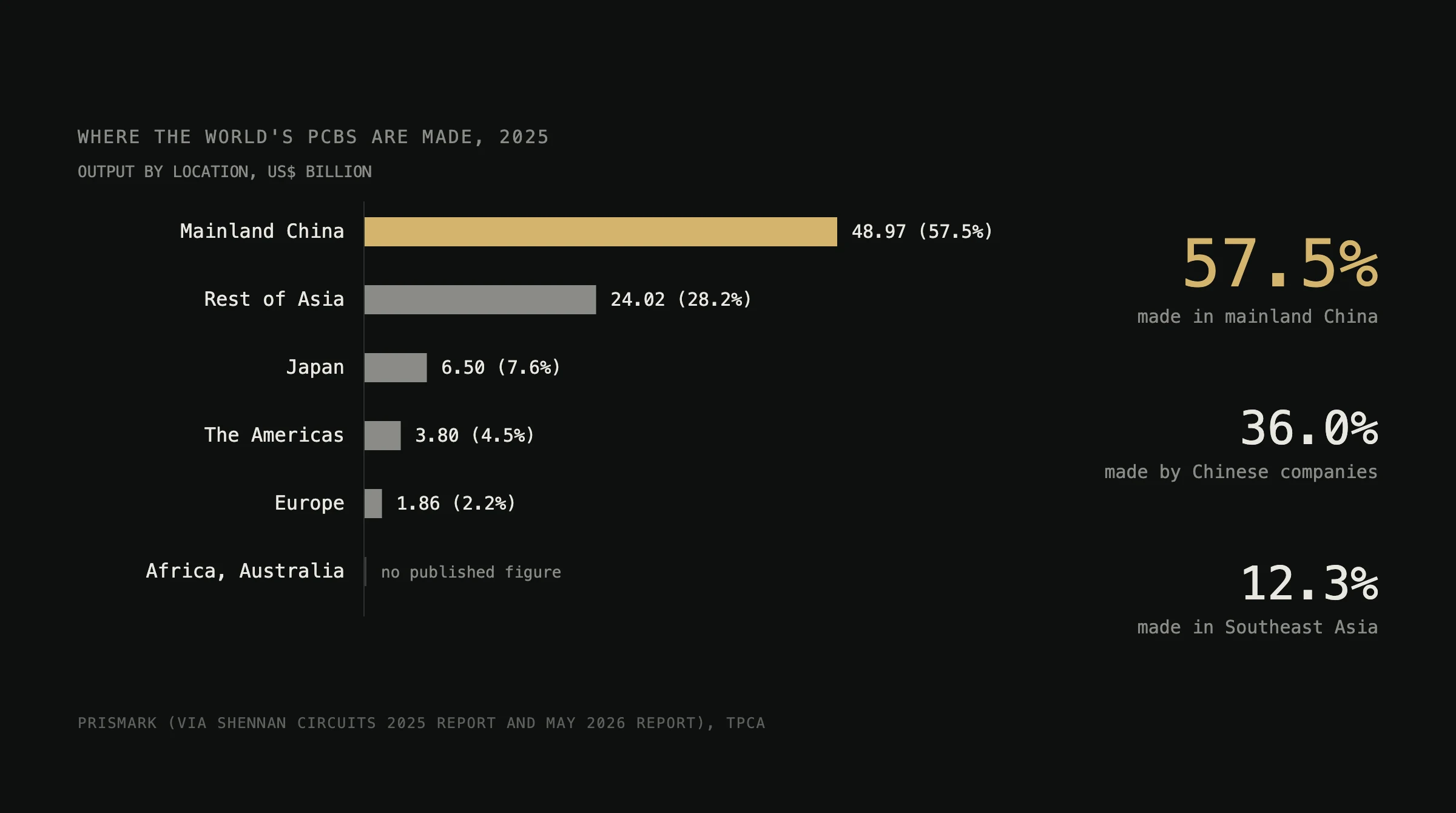
- Counted by where boards are made, mainland China made about 57.5% of the world's boards in 2025, the rest of Asia 28.2%, Japan 7.6%, the Americas 4.5% and Europe 2.2%.[4]
- Counted by where the company is based, Chinese companies made 36.0%, Taiwanese 29.7%, Japanese 11.0%, Korean 10.0%, American 6.7% and European 4.9%.[1]
- Southeast Asia makes about 12.3% of the world's boards, almost all of it in foreign-owned plants: locally owned makers account for about 1%.[5]
- No organisation publishes a production figure for Africa or Australia; board making there rests on a few named plants, among them ICAPE-TraX in Cape Town, FUBA in Tunisia and Lintek near Canberra.[6][7][8]
Two ways of counting
Board output is counted in two ways that give very different maps. Counted by location, a board made in a Taiwanese company's plant in Kunshan is Chinese output; counted by company, it is Taiwanese. Taiwanese makers produced 63.7% of their output in mainland China in the first quarter of 2026,[9] which is why China's share by location is far larger than its companies' share.
Totals also differ between counters. Prismark puts 2025 at US$85.8 billion,[1] the Taiwan Printed Circuit Association and ITRI at US$92.36 billion,[10] and the Korea Printed Circuit Association put 2024 at KRW 117.55 trillion, about US$86.17 billion.[11] This note gives each figure with its counter and does not mix them.
Where boards are made
Prismark's estimate of output by location, as published in Shennan Circuits' 2025 annual report, divides the world into five regions:[4]
| Region | 2025 output (US$ billion) | Share of the world | 2030 forecast (US$ billion) | Growth a year to 2030 |
|---|---|---|---|---|
| Mainland China | 48.97 | 57.5% | 68.54 | 7.0% |
| Asia outside Japan and mainland China | 24.02 | 28.2% | 38.26 | 9.8% |
| Japan | 6.50 | 7.6% | 9.47 | 7.8% |
| The Americas | 3.80 | 4.5% | 4.78 | 4.7% |
| Europe | 1.86 | 2.2% | 2.31 | 4.4% |
| World | 85.15 | 100% | 123.35 | 7.7% |
The shares and the world row are MPBxChange's arithmetic from the regional figures. Asia outside Japan and mainland China, which takes in Taiwan, South Korea, Southeast Asia and India, is expected to grow fastest, at 9.8% a year.[4]
Who makes them
Counted by the home of the company, Prismark's 2025 shares are:[1]
| Home of the company | Share of world output | US$ billion |
|---|---|---|
| Mainland China | 36.0% | 30.9 |
| Taiwan | 29.7% | 25.5 |
| Japan | 11.0% | 9.4 |
| South Korea | 10.0% | 8.6 |
| United States | 6.7% | 5.8 |
| Europe | 4.9% | 4.2 |
| Southeast Asia and the rest of the world | 1.7% | 1.4 |
The companies behind these shares are ranked in The world's largest PCB companies.
Asia
Mainland China
China is the world's board factory. Prismark expects its share of world production to reach about 60% by 2026, against less than 10% in 2000,[3] and 43 of Prismark's top 100 board makers have their headquarters there.[1] Chinese makers have begun to build abroad, but the move is still small: the Taiwan Printed Circuit Association estimates that their Thai plants make about 1.7% of their output.[12]
Taiwan
Taiwanese companies made about 30% of the world's boards and substrates in 2025, counting their plants in Taiwan, China and elsewhere.[1] Their output was NT$915.2 billion, 12% more than in 2024,[13] and in the first quarter of 2026 63.7% of it was made in mainland China, 32.3% in Taiwan and 4.0% in Southeast Asia.[9] In June the association expected NT$1,053.2 billion for 2026,[9] and in September it raised that to NT$1,136.5 billion, the first year above NT$1 trillion.[14] Zhen Ding, the largest board maker in the world, is Taiwanese.[1]
Japan
Japan made boards worth ¥610.6 billion in 2025, 12.0% more than in 2024, in government statistics compiled by the Japan Electronics Packaging and Circuits Association, and ¥451.8 billion in the first seven months of 2026.[15] Flexible boards made in Japan came to only ¥28.1 billion,[15] yet flexible circuits are about half of what Japanese-owned makers produce worldwide,[12] so most of them are made abroad. Japan's strength is in substrates: Ibiden plans to spend about US$3.2 billion over three years on capacity for AI and high-performance IC substrates.[1] Mektec is the world's largest maker of flexible circuits.[1]
South Korea
South Korea made KRW 12.64 trillion of boards in 2024, fourth in the world,[11] and about 60% of it was IC substrates.[16] Samsung Electro-Mechanics is expanding substrate capacity at its plant in Vietnam,[1] and ISU Petasys makes high-layer-count boards for data centre networks and AI accelerators in Daegu and in Hunan, China.[1]
Southeast Asia
Southeast Asia makes about 12.3% of the world's boards, but locally owned companies account for only about 1% of world output: the region's growth comes from plants built by Taiwanese, Chinese, Japanese, Korean, European and American companies.[5] More than US$10 billion of board capacity was committed to the region in the two years to May 2025.[17]
Thailand is the largest base, with output of US$5.06 billion in 2025, up 22.4% and about 5.4% of the world, and an expected US$6.09 billion in 2026.[5] Its Board of Investment counts 224 applications for investment promotion in the board sector, worth US$9.85 billion; these are applications, not money invested.[18] Vietnam made US$4.15 billion, up 33.9%, with US$4.9 billion expected in 2026,[5] and Malaysia US$2.09 billion, with US$2.41 billion expected.[5] The Austrian maker AT&S calls its plant in Kulim, Malaysia, the largest investment in its history.[19] Only two companies based in the region appear in Prismark's top 100: Thailand's KCE and Singapore's Gul Technologies, whose plants are in China.[1]
India
India needed boards worth about Rs 35,000 crore (about US$4.2 billion) in its 2024 to 2025 fiscal year, and imported 88% of them, mainly from China, Taiwan, South Korea and Southeast Asia, by the estimate of the industry association ELCINA, which says the country needs 10 to 12 large new plants.[20] The government approved its first projects under the Electronics Component Manufacturing Scheme in October 2025, among them multilayer and HDI board plants.[21] AT&S has made boards at Nanjangud since 1999.[19]
Europe
Europe made boards worth about US$1.86 billion in 2025, 2.2% of the world.[4] Data4PCB, presenting at the EIPC conference, gives a similar US$1.891 billion,[22] and reports that output grew 2.4% in euros while the world grew more than 11%.[23] Eleven makers left the industry in 2025, leaving 168 companies with 182 plants,[23] and Germany's board revenue has fallen by more than 27% since 2022.[23]
Europe keeps its niches. France makes about 41% of Europe's boards for defence electronics and the United Kingdom more than 28%, while Switzerland and Austria together make over 70% of its medical boards.[23] Prismark expects both Europe and the United States to concentrate further on aerospace and defence, medical, industrial and high-performance computing boards, with volume production staying in Asia.[1] The largest European maker, AT&S, has two plants in Austria that mainly supply Europe, and four in India, China and Malaysia.[19] Schweizer Electronic is based in Schramberg in the Black Forest,[24] and Italy's Somacis grew by 60.6% in 2025 through acquisitions, adding ACB's plants in Belgium and France in 2026.[1] NCAB of Sweden, a supplier in Prismark's top 100, buys its boards mainly from makers in Asia.[25]
The Americas
The Americas made about US$3.80 billion of boards in 2025, 4.5% of the world.[4] The Taiwan Printed Circuit Association puts the output of American companies at US$4.01 billion, fifth in the world, and expects more than US$4.4 billion in 2026 on defence and data centre demand.[26] The Global Electronics Association's monthly survey of makers in the United States and Canada showed a book-to-bill ratio of 1.29 in August 2026.[27]
Prismark expects the US market to be dominated more and more by large military suppliers.[17] TTM Technologies opened an ultra-HDI board and packaging plant in Syracuse, New York, in June 2026, a US$130 million investment that includes US$30 million from the US Department of War,[28] and Summit Interconnect makes boards for aerospace and defence, computing and medical uses.[1] In Canada, FTG Circuits makes complex HDI, RF and flex boards in Toronto, in two US plants and in Tianjin, China.[29] Further south, Circuitec describes itself as a Mexican maker of single-sided to multilayer boards,[30] and Micropress has made boards in São Paulo since 1986.[31]
Africa
No organisation publishes a board production figure for Africa. In Prismark's count by company home, Southeast Asia and the rest of the world together make 1.7% of world output.[1] Board making in Africa rests on a few plants. ICAPE-TraX in Cape Town, founded in 1991 as TRAX Interconnect and bought by the ICAPE Group in 2021, makes boards of up to 16 layers in standard production and 24 for prototypes.[6][32] Cirtech closed its Cape Town board plant in 2014.[33] In Tunisia, FUBA, part of the OneTech Group, produces up to 450,000 square metres of boards a year, including multilayer boards of up to 20 layers, and counts itself among the 30 largest makers of boards for vehicles,[7] and in January 2025 it signed a memorandum of understanding with China's Union Gain Electronics Technology.[34]
Australia and New Zealand
No production figure is published for Australia or New Zealand either. Lintek, in Queanbeyan near Canberra, makes microwave and high-frequency boards,[8] and defence work made up about 75% of its business in 2017.[35] B.E.C. Manufacturing in Lawnton, Queensland, describes itself as an Australian-owned board maker established in 1992.[36] Much of the region's demand is met by suppliers that source boards from Asia: in September 2026 NCAB, which buys mainly from Asian makers,[25] agreed to buy IMP Electronics Solutions of Adelaide.[37]
What the map means for buyers
Volume, AI server boards and most flexible circuits come from mainland China and from Taiwanese and Chinese companies' plants. New capacity is going to Southeast Asia, above all Thailand and Vietnam. Japan and South Korea lead in substrates, Europe and North America in defence, aerospace, medical and fast-turn work, and Africa and Australia have a few plants serving local industry and defence. The month's news from each region is in PCB industry update, October 2026, and Thailand's part in detail in Thailand's PCB build-out.
Data and method
This note draws on Prismark's published reports and its regional estimate as printed in Shennan Circuits' 2025 annual report, the Taiwan Printed Circuit Association and ITRI, the Japan Electronics Packaging and Circuits Association's compilation of government statistics, the Korea Printed Circuit Association as reported in the Korean press, Data4PCB's European figures as presented at the EIPC conference, the Global Electronics Association, the Thailand Board of Investment, ELCINA as reported by the Press Trust of India, and company websites and filings, all opened on 16 October 2026. The 2025 regional figures by location are Prismark's estimates from late 2025 and add up to US$85.15 billion, slightly below its final US$85.8 billion. Taiwan, South Korea, Southeast Asia and India are not separated in that table. Figures from different organisations count different things and are not combined. For Africa, Australia and New Zealand no production statistic was found, and the plants named are those that could be confirmed from their own websites or the trade press.
Sources
- data (2026). Global Leading PCB Companies – 2025 (Prismark Discovery Series). Prismark Partners LLC. back to text
- press (2026). Iran war disrupts the circuit board supply chain, raises costs for tech firms. Reuters (via Yahoo Finance). back to text
- data Prismark Research Featured in CNBC Report on Global PCB Supply Chains (What's New). Prismark Partners LLC. back to text
- data (2026). 深南电路股份有限公司2025年年度报告摘要 (Shennan Circuits 2025 annual report summary). Shennan Circuits Co., Ltd.. back to text
- data (2026). AI, Geopolitics Drive Southeast Asia's High-End PCB Ecosystem. TPCA (Taiwan Printed Circuit Association), published on I-Connect007. back to text
- company (2023). Technical Capability Summary (8.2.1.1) – ICAPE-TraX factory, South Africa. ICAPE Group. back to text
- company Printed Circuit Boards (PCB) – OneTech Group. OneTech Group (One Tech Holding). back to text
- company Lintek (company website). Lintek Pty Ltd. back to text
- data (2026). Taiwan Q1 2026 PCB Output Hits Record NT$245.6 Billion on AI Server Demand. TPCA (Taiwan Printed Circuit Association), published on I-Connect007. back to text
- data (2026). AI Reshapes the Industry Landscape: Global PCB Output to $105.2 Billion in 2026, Up 13.9% YoY. TPCA (Taiwan Printed Circuit Association), published on I-Connect007. back to text
- press (2025). 지난해 PCB 시장 규모 117조원…中 점유율 60% 압도적 1위. ZDNet Korea (reporting KPCA's 2024 Global PCB Production Report). back to text
- data (2025). TPCA Analyzes New Competitive Landscape of PCB Manufacturing in China, Japan, and South Korea. TPCA (Taiwan Printed Circuit Association), published on I-Connect007. back to text
- data (2026). TPCA Releases Taiwan PCB Industry Risk Governance Strategy. TPCA (Taiwan Printed Circuit Association), published on I-Connect007. back to text
- press (2026). AI帶旺 台灣PCB產值全年有望首度破兆元. Central News Agency (CNA). back to text
- data (2026). 電子回路基板生産動向 (JPCA statistics workbook kikai_toukei.xlsx). Japan Electronics Packaging and Circuits Association (JPCA), compiled from METI Current Production Statistics (経済産業省生産動態. back to text
- press (2025). 中, 전세계 PCB 점유율 60% 이상 차지···한국은 첨단 패키징용 기판 강점. Sisa Journal-e (reporting KPCA). back to text
- data (2025). Global Leading PCB Companies (Prismark Discovery Series, top 100 PCB companies 2024). Prismark Partners LLC. back to text
- official (2026). Thailand Attracts $26.8 Billion Investment Surge in High-Tech Electronics as Chip Supply Chains Shift. Thailand Board of Investment (BOI) One Start One Stop Investment Center. back to text
- company AT&S worldwide (company locations page). AT&S Austria Technologie & Systemtechnik AG. back to text
- press (2025). India needs 10-12 new big PCB units with Rs 20K cr investment to cut reliance on imports Elcina. PTI, published by The Week (reporting an ELCINA report). back to text
- press (2025). MeitY Approves Seven Electronics Manufacturing Projects Worth ₹5,532 Crore. News On AIR (All India Radio). back to text
- press (2026). EIPC Winter Conference 2026 Review: The Keynote Sessions. I-Connect007 (reporting Dieter Weiss, in4ma/Data4PCB, at the EIPC Winter Conference). back to text
- press (2026). European PCB revenues rise 2.4% as industry shrinks. Evertiq (reporting Data4PCB data). back to text
- company Schweizer Electronic AG website (English home page). Schweizer Electronic AG. back to text
- company NCAB in short. NCAB Group AB (investor relations). back to text
- data (2026). Taiwan to showcase high-end packaging at APEX EXPO 2026. TVBS News (reporting TPCA and ITRI data). back to text
- data (2026). North American PCB Shipments Jump 23.5% in August, Extending Strong 2026 Growth. Global Electronics Association (formerly IPC). back to text
- company (2026). TTM Technologies Opens Ultra-HDI Manufacturing Facility in Syracuse, NY, Advancing America's Defense Electronics Industrial Base. TTM Technologies, Inc. (GlobeNewswire release). back to text
- company About FTG Circuits. Firan Technology Group Corporation. back to text
- company Circuitec (company website, English). Circuitec, S. de R.L. de C.V.. back to text
- company Micropress (company website). Micropress S/A. back to text
- press (2021). ICAPE Group enters SA market with acquisition of TRAX. Dataweek (Technews Publishing). back to text
- press (2014). Cirtech to Liquidate S. Africa PCB Assets. PCD&F / Printed Circuit Design & Fab. back to text
- press (2025). FUBA, filiale de One Tech Holding signe un protocole d’accord avec la société chinoise Union Gain Electronics Technology. Tunisie Numérique. back to text
- press (2017). Defence positions Lintek for growth. Australian Defence Magazine. back to text
- company B.E.C. Manufacturing (company website). B.E.C. Manufacturing Pty Ltd. back to text
- company (2026). NCAB acquires IMP Electronics Solutions in Australia. NCAB Group. back to text
How to cite: MPBxChange (2026). The world PCB industry by region: Asia, Europe, the Americas, Africa and Australia. MPBxChange research. https://www.mpbxchange.com/research/world-pcb-industry-by-region