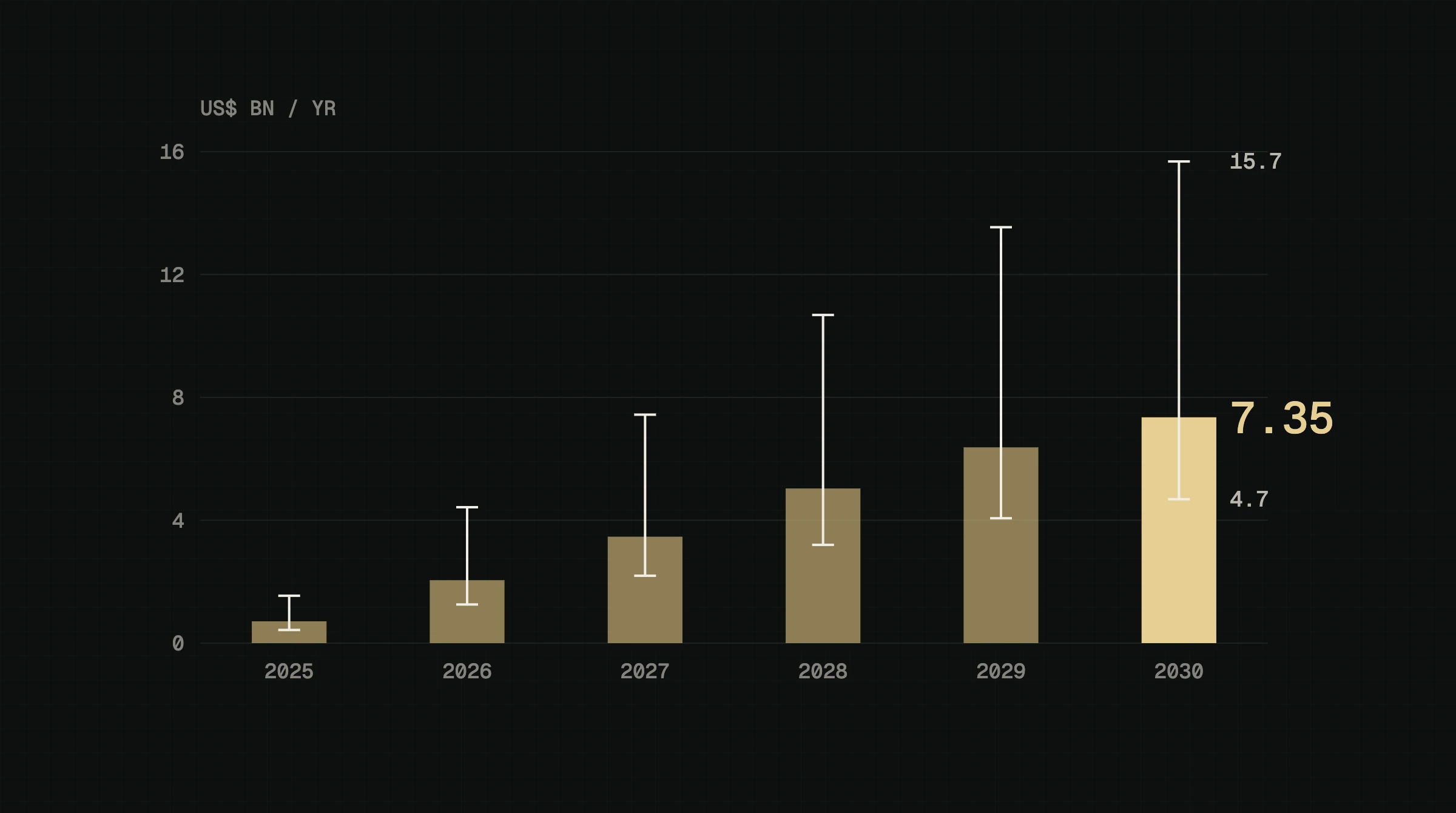
Twenty-nine of the PCB plants in the MPBxChange register have a published investment figure: a company filing, a Board of Investment (BOI) release or a company statement that says what the owner is spending in Thailand. At Bank of Thailand rates they add up to US$7.83 billion across 35 tranches.[1] This article turns those amounts into bare-board output, year by year, with a method a reader can redo: each dollar of plant earns a range of revenue taken from the accounts of listed board makers, each plant starts when its owner said it would and fills over a ramp drawn from the cases the register documents, and 10,000 runs of that arithmetic give a range rather than one number. In the most likely case the announced plants produce US$3.46 billion of bare boards a year by 2027 and US$7.35 billion by 2030, with 10th to 90th percentile ranges of US$2.19 to 7.44 billion and US$4.69 to 15.68 billion. Set against what they already produced in 2025, that is far more than the export forecast expects exports to grow, which is the buyer's opportunity.
Key points
- The pipeline is large and mostly disclosed. 29 plants publish an amount, 35 tranches in all, US$7.83 billion at the Bank of Thailand rates of 25 September 2026.[1] Another 4 new plants publish no amount and are listed as not disclosed, not guessed.
- Output, with its spread. The announced plants most likely produce US$3,465 million a year in 2027, US$5,035 million in 2028 and US$7,352 million in 2030; the 10th to 90th percentile range for 2030 is US$4,685 to 15,682 million. Over their 2025 level, the most likely increase is US$2,756 million by 2027 and US$6,653 million by 2030.
- Prachin Buri leads. Prachin Buri adds the most, US$3,420 million a year by 2030 in the most likely case, then Phra Nakhon Si Ayutthaya with US$1,490 million. By parent country, plants with Chinese parents produce US$3,701 million and plants with Taiwanese parents US$3,308 million.
- The pipeline supports the export forecast with room to spare. The forecast's most likely path has exports US$704 million above 2025 by 2030, which is 11% of the most likely increase in the plants' output. Even the forecast's 95% high needs only 62% of it.
- Five markets carry the export growth. Exports rose 29.9% in total from 2019 to 2025, from US$1,214.1 million to US$1,576.9 million.[5][6] China, the United States, Japan, Vietnam and India together added US$467.5 million, more than the total change of US$362.9 million, because shipments to some older markets fell.
Why count the plants this way
Show the numbers
| Year | 10th percentile, US$ m | Most likely, US$ m | 90th percentile, US$ m | Forecast growth over 2025, most likely | Forecast growth over 2025, 95% high |
|---|---|---|---|---|---|
| 2026 | 820 | 1,340 | 2,916 | 530 | 912 |
| 2027 | 1,735 | 2,756 | 5,937 | 556 | 1,955 |
| 2028 | 2,736 | 4,324 | 9,257 | 592 | 2,874 |
| 2029 | 3,600 | 5,670 | 12,084 | 635 | 3,543 |
| 2030 | 4,230 | 6,653 | 14,205 | 704 | 4,146 |
The BOI reports that PCB and PCB-material makers filed 222 applications worth THB 320,078 million from 2023 to 2025.[4] That headline mixes board plants with laminate and chemical plants, and applications with money spent. The register takes the other route: one plant at a time, with the amount its owner has published, its status and its dates. Investment is what companies disclose; output is what buyers, planners and competitors need to know. The link between the two is how much revenue a dollar of plant earns once the plant is full, and listed board makers publish the figures that answer it every year in their accounts. The answer varies between companies, and that variation is the honest uncertainty in any output figure built this way. This article keeps it in view by reporting a 10th, a 50th and a 90th percentile rather than one number.
The pipeline from the register
The table lists every tranche with a published amount, as the register recorded it on 26 September 2026. A plant appears more than once when a second phase has its own amount. The start is the month the owner reported or targeted for production, or "not published" where the model has to assume one (step 4 below).
| Plant | Parent country | Province | Tranche | Amount as published | US$ m | Start | Basis |
|---|---|---|---|---|---|---|---|
| Advanced Interconnection Technology (AITC) | Thailand | Pathum Thani | Plant (SVI and CCTC joint venture) | THB 4,500 m | 135 | 2026-10 | target |
| Allfavor Circuit (Thailand) | China | Samut Prakan | Thailand PCB base | CNY 300 m | 45 | not published | assumed |
| Aohong Electronics (Thailand) | China | Prachin Buri | Thailand production base | CNY 596 m | 89 | 2026-05 | disclosed |
| Apcb Electronics (Thailand) (Victory Giant) | China | Phra Nakhon Si Ayutthaya | Thailand high-multilayer PCB project | CNY 1,402 m | 209 | 2025-03 | disclosed |
| CMK Corporation (Thailand) | Japan | Prachin Buri | New factory first phase | JPY 25,000 m | 158 | 2024-08 | disclosed |
| Compeq (Thailand) | Taiwan | Samut Prakan | Phase 1 (rigid and HDI) | THB 13,000 m | 389 | 2024-12 | disclosed |
| Compeq (Thailand) | Taiwan | Samut Prakan | Phase 2 (flexible PCB) | THB 9,170 m | 274 | not published | assumed |
| Draco PCB (Chin Poon Electronics (Thailand)) | Taiwan | Pathum Thani | New plant on the existing site | THB 1,000 m | 30 | not published | assumed |
| Dynamic Technology Manufacturing (Thailand) | Taiwan | Prachin Buri | Second plant (AI computing high-end PCB) | CNY 3,315 m | 494 | 2028-01 | target |
| First Quality Circuit (Sihui Fuji Electronics) | China | Rayong | Thailand base (capital increases 2025) | CNY 550 m | 82 | 2024-06 | disclosed |
| Gold Circuit Electronics (Thailand) | Taiwan | Prachin Buri | Phase one | THB 8,000 m | 239 | 2025-07 | disclosed |
| Gold Circuit Electronics (Thailand) | Taiwan | Prachin Buri | Phase two | THB 7,230 m | 216 | 2027-10 | target |
| Guanghe Technology (Thailand) (Delton) | China | Prachin Buri | Thailand works (phase 1 and phase 2) | CNY 1,232 m | 184 | 2025-06 | disclosed |
| IFOUND PCB (Thailand) | China | Prachin Buri | Thailand base | CNY 1,432 m | 213 | 2025-08 | disclosed |
| Kinwong Electronic (Thailand) | China | Prachin Buri | Thailand base (initial plus fit-out) | CNY 1,400 m | 209 | 2026-09 | disclosed |
| Mektec Manufacturing (Thailand) | Japan | Phra Nakhon Si Ayutthaya | FPCB and FPCBA expansion | THB 920 m | 28 | not published | assumed |
| Multi-Fineline Electronics (Thailand) (MFLEX) | China | Chon Buri | Phase one | THB 14,000 m | 419 | 2025-01 | disclosed |
| Multi-Fineline Electronics (Thailand) (MFLEX) | China | Chon Buri | Phase two | THB 5,800 m | 174 | not published | assumed |
| Olympic Circuit (Thailand) | China | Chachoengsao | Thailand plant (phase 1) | USD 200 m | 200 | 2026-01 | disclosed |
| Peng Shen Technology (Thailand) (Zhen Ding) | Taiwan | Prachin Buri | Phase 1 (cumulative actual to Dec 2025) | CNY 1,952 m | 291 | 2025-09 | disclosed |
| Peng Shen Technology (Thailand) (Zhen Ding) | Taiwan | Prachin Buri | 2026 park investment plan (phases II III V and drilling centre) | CNY 4,297 m | 640 | not published | assumed |
| Peng Shen Technology (Thailand) (Zhen Ding) | Taiwan | Prachin Buri | Remainder of four BOI-promoted projects | THB 33,900 m | 1,014 | 2029-06 | assumed |
| QuanTech Circuit (Thailand) | China | Phra Nakhon Si Ayutthaya | Thailand production base | CNY 550 m | 82 | 2026-08 | disclosed |
| Shengyi Electronics (Thailand) | China | Chachoengsao | Thailand PCB base | USD 170 m | 170 | 2026-09 | target |
| Shennan Circuits (Thailand) | China | Phra Nakhon Si Ayutthaya | Thailand plant | CNY 1,274 m | 190 | 2025-09 | disclosed |
| Sundell Technology (Aoshikang) | China | Phra Nakhon Si Ayutthaya | Thai site | USD 174 m | 174 | 2024-08 | disclosed |
| Suntak Technology (Thailand) | China | Prachin Buri | Phase 1 | CNY 1,000 m | 149 | 2027-03 | target |
| Taihua Electronics Technology (Ellington) | China | Prachin Buri | Phase 1 buildings and equipment | CNY 560 m | 83 | 2026-03 | disclosed |
| Thai Kun Circuit (ManKun Technology Thailand) | China | Prachin Buri | Thailand high-end PCB base | CNY 502 m | 75 | 2027-07 | target |
| Unimicron (Thailand) | Taiwan | Chachoengsao | Thai subsidiary (cumulative paid-in) | THB 9,419 m | 282 | 2026-10 | target |
| Unitech PCB (Thailand) | Taiwan | Ang Thong | Thai subsidiary (cumulative investment) | THB 3,500 m | 105 | 2026-07 | disclosed |
| Well Tek Electronics (Welgao) | China | Phra Nakhon Si Ayutthaya | Phase I | THB 2,500 m | 75 | 2024-06 | disclosed |
| WTT Electronics (Zhongfu Circuit) | China | Rayong | Thailand base | CNY 500 m | 75 | 2025-01 | disclosed |
| WUS Printed Circuit (Thailand) | China | Phra Nakhon Si Ayutthaya | C5P1 phase 1 | CNY 2,700 m | 402 | 2024-10 | disclosed |
| WUS Printed Circuit (Thailand) | China | Phra Nakhon Si Ayutthaya | C5P2 phase 1 | CNY 1,600 m | 238 | 2026-06 | disclosed |
US$ conversions at the Bank of Thailand rates of 25 September 2026.[1] The three phase-two amounts for Compeq, Multi-Fineline and Gold Circuit, and their phase-one amounts of THB 13,000, 14,000 and 8,000 million, come from the BOI's release of 18 May 2026.[4] Two tranches use the parent's cumulative paid-in capital in its Thai subsidiary (Unimicron and Unitech), which is a floor for what the plant cost, not the cost itself. The last Peng Shen tranche is the least certain: the register records more than THB 65 billion across four BOI-promoted projects, and the model places the part not yet covered by the parent's stated spending in 2029.
Four new plants publish no amount:
- AKM Meadville Electronics (Thailand) (China, Phra Nakhon Si Ayutthaya, under construction): No investment figure published; registered capital only.
- STARTEAM GLOBAL (Prachinburi STARTEAM) (Hong Kong, Prachin Buri, operating): No investment figure published.
- SYKC Circuit (Thailand) (China, Rayong, operating): No investment figure published.
- Dynamic Technology Manufacturing (Thailand) first plant (Taiwan, Prachin Buri, operating): First-plant investment not published (USD 59.8 m injected in 2025 is a partial figure); the second plant is in the pipeline table.
Seven established plants have no announced project amount and are outside the pipeline:
- Apex Circuit (Thailand) (Taiwan, Samut Sakhon, since 2001): About 1 million sqm/month across four Thai plants; no announced project amount.
- Shye Feng (Taiwan, Samut Sakhon, since 1990): Apex International plant; no announced project.
- Autech (Thailand) (Taiwan, Chachoengsao, since 1989): No announced project.
- Circuit Industries (Thailand, Samut Sakhon, since 1990): No announced project.
- Fujikura Electronics (Thailand) (Japan, Phra Nakhon Si Ayutthaya, since 2010): No announced project amount.
- Elec & Eltek (Thailand) (Hong Kong, Pathum Thani, since 1987): Kingboard's separate Ayutthaya project (1.2 million sq ft a month planned, first phase 600,000 sq ft due 2027) is not a register plant and has no published amount.
- KCE Electronics (Thailand, Bangkok, since 1982): THB 8,060 m Rojana factory (Nov 2022) postponed in 2025; excluded from the pipeline.
A design capacity in square metres is published for 12 of the tranches. Those capacities add up to 10,460,500 square metres a year, or 871,708 square metres a month, at full output.
How the calculation works
The steps below are the steps of the script, with Kinwong Electronic (Thailand) as the worked example.
- Read the register. 35 tranches at 29 plants publish an amount. Kinwong's parent approved up to CNY 700 million for a new production base in Thailand in September 2023,[2] and up to CNY 700 million more for fit-out, production lines and equipment in March 2026, when the plant had not yet started production.[3] The register records the production start ceremony on 13 September 2026. Amount: CNY 1,400 million; start: September 2026, disclosed.
- Convert to US dollars. The Bank of Thailand's rates for 25 September 2026: 33.425 baht per US dollar (the weighted-average interbank rate), and the midpoint of the counter rates for the others: 4.9813 baht per yuan, 21.0888 baht per 100 yen and 1.05095 baht per Taiwan dollar.[1] Kinwong: CNY 1,400 million times 4.9813 divided by 33.425 = US$208.6 million.
- Turn investment into full-ramp revenue. An announced investment is a gross cost, so the right ratio is revenue over what the plant cost to build, not over its depreciated book value. The MPBxChange financials panel computes it from the filings of listed bare-board makers as each company's revenue divided by its capital spending over the previous ten years (see what the listed makers' accounts say). Across 115 company-years of 30 makers from 2016 to 2025 the ratio has a median of 1.07, a 10th to 90th percentile range of 0.71 to 2.28 and a full range of 0.37 to 3.97. Kinwong's own parent runs at 1.05, close to the median. The model draws from that distribution. Revenue over net property, plant and equipment is higher, a median of 1.97 across 342 company-years of 38 makers (1.16 to 3.53), because net plant is stated after depreciation; it is reported below as a high-side sensitivity, not the central case. Kinwong at full ramp: US$208.6 million times 0.71, 1.07 or 2.28 = US$148, 224 or 476 million a year.
- Set the timing. A tranche starts on its reported date (disclosed); on its targeted date with a slip of 3 months early to 9 months late (target); or, where no date is published, at groundbreaking or approval plus a construction time drawn from the 16 register plants that report both groundbreaking and start, 13 to 30 months with a median of 18 months (assumed). Output then rises in a straight line to full ramp. Where the register gives a full-output date (Victory Giant, Mankun, Welgao, WTT and WUS), the line runs to that date: 1.3 to 4.4 years after the start in those 5 cases. For the other tranches the ramp time is drawn from a log-normal distribution with a median of 2.5 years and a 10th to 90th percentile range of 1.4 to 4.5 years, chosen to span the disclosed cases. The timing comes from the register and not from the panel's accounts: in those accounts capital spending follows the same year's demand, so they cannot say how fast a new plant fills.
- Run it 10,000 times. Each run draws one revenue ratio and one timing for every tranche, then adds up the output in each year from 2025 to 2030. One ratio per run applies to every plant, so the spread between companies is not averaged away. The 10th, 50th and 90th percentiles of the 10,000 totals are reported. Kinwong's mean output across the runs: US$96 million in 2027, US$196 million in 2028 and US$266 million in 2030.
- Cross-check. The increase in output over 2025 is set against Thailand's 2025 exports of bare boards and the export forecast.
- Per month. Annual output divided by 12 and, where a filing gives revenue per square metre, an implied board area.
- Demand side. A shift-share of exports by destination, 2019 against 2025, shows which markets carry the growth.
The ranges are prediction intervals in the ordinary sense: ranges expected to hold the outcome with the stated probability, given the model.[8]
What the plants add, by year
| Year | Output: 10th percentile | Most likely (50th) | 90th percentile | Over 2025: 10th | Most likely | 90th |
|---|---|---|---|---|---|---|
| 2025 | 428 | 710 | 1,543 | |||
| 2026 | 1,258 | 2,049 | 4,425 | 820 | 1,340 | 2,916 |
| 2027 | 2,194 | 3,465 | 7,438 | 1,735 | 2,756 | 5,937 |
| 2028 | 3,199 | 5,035 | 10,684 | 2,736 | 4,324 | 9,257 |
| 2029 | 4,065 | 6,375 | 13,541 | 3,600 | 5,670 | 12,084 |
| 2030 | 4,685 | 7,352 | 15,682 | 4,230 | 6,653 | 14,205 |
US$ million a year. Output is what the tranches in the table above produce in the year; over 2025 is the increase on what the same plants produced in 2025, when several of them were already running. At full ramp, whenever each plant reaches it, the announced plants produce US$5,545, 8,407 or 17,798 million a year (10th, 50th and 90th percentiles). With the high-side ratio (revenue over net plant) the most likely 2030 output would be US$13,466 million. If the four undisclosed plants are given their registered capital as a floor, the most likely 2030 output rises to US$7,682 million.
By province:
| Province | Plants with an amount | 2027: 10th / 50th / 90th | 2030: 10th / 50th / 90th |
|---|---|---|---|
| Prachin Buri | 11 | 676 / 1,130 / 2,467 | 2,104 / 3,420 / 7,366 |
| Phra Nakhon Si Ayutthaya | 7 | 713 / 1,138 / 2,457 | 967 / 1,490 / 3,164 |
| Samut Prakan | 2 | 193 / 375 / 819 | 438 / 716 / 1,549 |
| Chachoengsao | 3 | 118 / 240 / 545 | 418 / 677 / 1,444 |
| Chon Buri | 1 | 202 / 392 / 859 | 379 / 611 / 1,312 |
| Rayong | 2 | 75 / 127 / 273 | 110 / 168 / 355 |
| Pathum Thani | 2 | 10 / 30 / 88 | 99 / 168 / 361 |
| Ang Thong | 1 | 20 / 45 / 111 | 66 / 110 / 235 |
By the home country of the parent company:
| Parent country | Plants with an amount | 2027: 10th / 50th / 90th | 2030: 10th / 50th / 90th |
|---|---|---|---|
| China | 19 | 1,461 / 2,320 / 5,000 | 2,407 / 3,701 / 7,836 |
| Taiwan | 7 | 556 / 954 / 2,073 | 2,032 / 3,308 / 7,172 |
| Japan | 2 | 93 / 170 / 369 | 128 / 198 / 419 |
| Thailand | 1 | 8 / 26 / 81 | 79 / 138 / 297 |
Cross-check against the trade data
Thailand exported US$1,576.9 million of bare boards (HS 8534) in 2025.[5] The Taiwan Printed Circuit Association puts Thailand's PCB output at US$5.06 billion in 2025, up 22.4% year-on-year, and expects US$6.09 billion in 2026, up 20.4% year-on-year;[7] the gap between output and exports is the boards sold to assemblers in Thailand and the boards that leave inside finished products. TPCA's figures imply that output rose by about US$0.93 billion in 2025, from US$4.13 billion (5.06 divided by 1.224; this article's arithmetic), and will rise by US$1.03 billion in 2026. The model is consistent with both: the announced plants most likely produced US$710 million in 2025 (US$428 to 1,543 million), and their most likely increase in 2026 is US$1,340 million (US$820 to 2,916 million).
The export forecast, built from the monthly trade returns alone, puts 2026 exports at a most likely US$2,107 million and 2030 at US$2,281 million, with a 95% range of US$1,136 to 5,723 million for 2030. Its growth over 2025 can be set against the increase in the announced plants' output over the same base:
| Year | Pipeline over 2025: 10th | Most likely | 90th | Export forecast: most likely growth over 2025 | 95% high growth over 2025 |
|---|---|---|---|---|---|
| 2026 | 820 | 1,340 | 2,916 | 530 | 912 |
| 2027 | 1,735 | 2,756 | 5,937 | 556 | 1,955 |
| 2028 | 2,736 | 4,324 | 9,257 | 592 | 2,874 |
| 2029 | 3,600 | 5,670 | 12,084 | 635 | 3,543 |
| 2030 | 4,230 | 6,653 | 14,205 | 704 | 4,146 |
US$ million a year. The forecast's most likely path needs 11% of the most likely increase in output to be exported by 2030, and its 95% high needs 62%. Even at the pipeline's 10th percentile, the forecast's most likely growth is 17% of the increase. The same holds in 2027 (20% and 71%) and 2028 (14% and 66%).
The verdict is plain. The pipeline supports the export forecast: a modest export share of the new output is enough to reach its most likely path, and the upper part of the forecast's range is the better guide while the plants ramp. The trade returns already say so. Exports of bare boards in January to May 2026 were US$833.4 million, 39.4% more than the US$597.9 million of the same months of 2025,[9] and the Office of Industrial Economics reports US$232 million in July 2026 alone, 78.8% more than a year earlier.[10] Over the same months the listed Taiwanese makers' monthly revenue grew far less (the accounts article puts it at 24.7% year-on-year for January to May and 26.0% for July); the difference is the new capacity in Thailand. The gap between pipeline and forecast is the opportunity for buyers: plants that are qualifying customers, quoting and filling lines in Thailand now.
The opportunity, per month
Divided by 12, the announced plants' most likely output is US$289 million a month in 2027 (10th to 90th percentile US$183 to 620 million), US$420 million a month in 2028 (US$267 to 890 million) and US$613 million a month in 2030 (US$390 to 1,307 million).
No filing in the financials panel gives revenue per square metre of board, so the model stops at the dollar figure rather than invent a price. The register's own design capacities give the area side for the 12 tranches that publish one: 871,708 square metres a month at full output.
Where the exports go
A shift-share decomposition splits the change in exports to each destination into the part it would have shown had it grown at the world rate, and the rest, the shift. Thailand's bare-board exports rose 29.9% in total from 2019 to 2025, from US$1,214.1 million to US$1,576.9 million, across 93 destinations in 2019 and 87 in 2025.[5][6]
| Destination | 2019 | 2025 | Change | Expected at the world rate | Shift |
|---|---|---|---|---|---|
| China | 226.1 | 407.3 | 181.2 | 67.6 | 113.7 |
| United States | 127.3 | 243.8 | 116.5 | 38.1 | 78.4 |
| Japan | 112.4 | 174.6 | 62.1 | 33.6 | 28.5 |
| Vietnam | 79.1 | 135.7 | 56.6 | 23.6 | 33.0 |
| India | 23.1 | 74.1 | 51.0 | 6.9 | 44.1 |
| South Korea | 43.5 | 59.4 | 15.9 | 13.0 | 2.9 |
| Malaysia | 57.0 | 58.5 | 1.5 | 17.0 | -15.5 |
| Germany | 67.9 | 56.0 | -11.9 | 20.3 | -32.1 |
| Indonesia | 34.6 | 41.9 | 7.3 | 10.3 | -3.0 |
| United Kingdom | 40.3 | 37.1 | -3.2 | 12.0 | -15.2 |
| Mexico | 28.2 | 27.6 | -0.6 | 8.4 | -9.0 |
| Romania | 24.3 | 26.6 | 2.3 | 7.3 | -5.0 |
US$ million, the twelve largest destinations of 2025. Expected at the world rate is the 2019 value times 29.9%; shift is the change less that amount.
China, the United States, Japan, Vietnam and India carried the growth: their combined change of US$467.5 million exceeded the total change of US$362.9 million, and their combined shift of US$297.8 million is most of the US$334.5 million of positive shift. China's share of Thai bare-board exports rose from 18.6% to 25.8%, the United States' from 10.5% to 15.5% and India's from 1.9% to 4.7%. The largest shifts the other way were Laos (US$61.9 million to 7.3 million); Germany (US$67.9 million to 56.0 million); Singapore (US$33.9 million to 13.7 million); Hong Kong (US$41.4 million to 26.3 million); Hungary (US$38.0 million to 23.7 million); Philippines (US$25.8 million to 14.2 million). For a plant in Thailand the pattern is a map of where its neighbours' boards already go: to assemblers in China, Vietnam and India as well as to the United States and Japan.
Limits
The register is compiled from public records, so the pipeline holds what owners have published, in the currencies and at the dates they published it; amounts announced as ceilings ("up to") may not be spent in full, and cumulative or paid-in figures may be below the final cost. Four new plants publish no amount and count as zero in the main run. The revenue ratio describes listed companies as a whole over ten years of spending, not a first-year plant in Thailand; its range is wide for that reason, and the article reports the range rather than a point. The panel's regressions of revenue on past capital spending were not used for the ramp: in those accounts capital spending follows the same year's demand and past spending has no significant effect on later revenue, so they cannot say how fast a new plant fills; the ramp comes from the register's disclosed timelines and a stated assumption. Start dates are the owners' targets, which can move either way. Output is revenue at the plant, not exports: some of it will be sold in Thailand, and boards that leave inside finished products are not counted under HS 8534. The Bank of Thailand rates are those of one day. Kingboard's separate Ayutthaya project and KCE's postponed Rojana factory are outside the pipeline because one has no published amount and the other no current start. The shift-share uses Thailand's own returns to UN Comtrade, which record the declared destination, not the final user.
The output figures assume each plant fills at the rate the listed makers reach on average: they measure what the new capacity can produce, not a forecast of orders. The accounts article finds that the makers' existing plant could already carry about a quarter more sales, so some new plants may run below that rate for longer than their owners plan.
How this was researched
This article was researched on 26 and 27 September 2026 from the MPBxChange register of PCB plants in Thailand, read through the same loader the site uses, together with the register's ownership records; the Bank of Thailand's daily rate sheet; the Kinwong filings of September 2023 and March 2026 and the BOI release of 18 May 2026, for the worked example and the phase-two approvals; Thailand's returns to UN Comtrade for HS 8534 exports by partner in 2019 and 2025 and by month for January to May 2025 and 2026; the OIE report for July 2026; the TPCA release on Southeast Asian output; and the MPBxChange financials panel of listed bare-board makers, which supplies the revenue ratios from company filings (Eastmoney F10 for the Shanghai and Shenzhen filings, FinMind for the Taiwan filings). The calculation is one reproducible script with a fixed random seed, 10,000 draws and the data it read stored beside it; every figure in the tables above comes from that run.
Sources
- official Bank of Thailand (2026). Foreign Exchange Rates as of 25 September 2026 (daily sheet; the link shows the latest day, the archive is at app.bot.or.th, report 123). Bank of Thailand, thaifxrates.net. back to text
- company Shenzhen Kinwong Electronic Co., Ltd. (2023). 景旺电子关于在泰国投资新建生产基地的公告 (2023-083): announcement on investing in a new production base in Thailand. Shanghai Stock Exchange filing via CNINFO. back to text
- company Shenzhen Kinwong Electronic Co., Ltd. (2026). 景旺电子关于增加泰国生产基地投资额度的公告 (2026-016): announcement on increasing the investment quota for the Thailand production base. Shanghai Stock Exchange filing via CNINFO. back to text
- official Office of the Board of Investment (BOI), Thailand (2026). บีโอไออนุมัติ 3 โครงการใหญ่ PCB ขยายลงทุนเฟสสอง 2 หมื่นล้าน (ข่าวสำหรับสื่อมวลชน ฉบับที่ 73/2569). Thailand Board of Investment. back to text
- data United Nations Statistics Division (2026). UN Comtrade: Thailand, HS 8534 printed circuits, exports by partner, annual, 2025 (the link opens 2025; change the period for 2019). UN Comtrade database, public API. back to text
- data United Nations Statistics Division (2026). UN Comtrade: Thailand, HS 8534 printed circuits, exports by partner, annual, 2019. UN Comtrade database, public API. back to text
- official Taiwan Printed Circuit Association (TPCA) (2026). 地緣、AI雙引擎!泰越馬形塑東南亞高階PCB黃金生態系. Taiwan Printed Circuit Association. back to text
- academic Hyndman, R. J.; Athanasopoulos, G. (2021). Forecasting: Principles and Practice, 3rd edition, section 5.5: Distributional forecasts and prediction intervals. OTexts, Melbourne. back to text
- data United Nations Statistics Division (2026). UN Comtrade: Thailand, HS 8534 printed circuits, exports, monthly, January to May 2025 and 2026 (the link opens May 2026; change the period for other months). UN Comtrade database, public API. back to text
- official Office of Industrial Economics (OIE), Ministry of Industry (2026). ภาวะเศรษฐกิจอุตสาหกรรม เดือนกรกฎาคม 2569 (Industrial economic conditions, July 2026). Office of Industrial Economics. back to text
How to cite: MPBxChange (2026). What the announced PCB plants add up to: Thailand's bare-board output to 2030. MPBxChange research. https://www.mpbxchange.com/research/thailand-pcb-pipeline-output-2027-2030